
Free your mind and the rest will follow: Why Liberation Matters

Black and white photo of a woman wearing a white vest and jeans, sitting cross-legged and playing a small singing bowl.
What is liberation and what does it have to do with counseling?
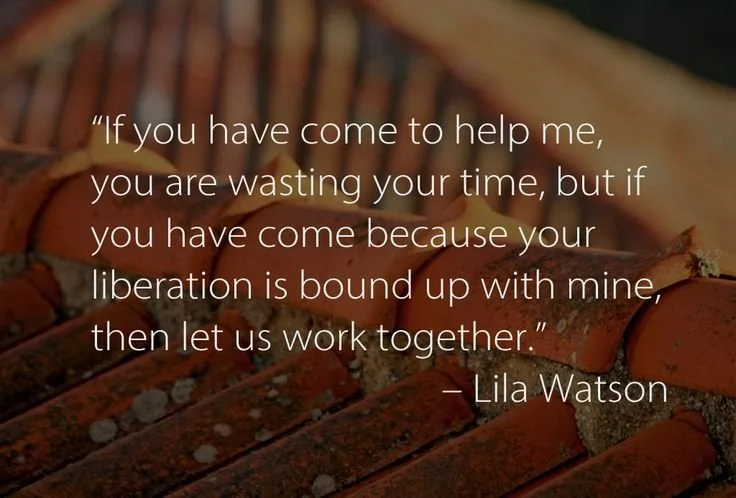
The definition of liberation is the act of setting someone free from imprisonment, slavery or oppression. When applied to the field of counseling a liberation framework is an approach that seeks to dismantle systems of oppression, inequality and injustice. In the current field of an oppressive government that enables institutions to systemically harm and oppress marginalized people and communities this framework is vital to being trauma-informed and culturally reflexive counselors. Through this framework the hope is to create a space in which marginalized folx can actively participate in their liberation and transformation. Liberation work often incorporates the idea of “critical consciousness,” an idea introduced by Paulo Freire around questioning and being curious around our own ways of being, ideas we have about our lived experience and where these ideas may be stemming from. Liberation is a dual process involving both counselor and client being willing and able to engage with their own conditioning and the impact this has on any relationship and space.
“But, I don’t do politics in therapy.”
The idea that therapists can be separate from the systems and institutions in which they are embedded is one of spiritual bypassing and privilege. The idea that because these things are not impacting you directly, they don’t matter or are simply not real is harmful and concerning. Therapists must recognize that choosing to not engage in political topics in counseling is a matter of implicit biases. How do you imagine truly understanding someone or being curious about their lived experience if we are not attentive to the external factors that have an impact on them. As we see on the news, politics touches us all, our policies, laws and embedded Christian Nationalist and white supremacist rhetoric within these spaces has a real, negative and sometimes deadly impact on ourselves, our communities and those we serve.
Why liberation matters….
As we see all around us, we often lack control. In an oppressive government that hopes to condition us to see our neighbors and community as less than we must actively participate in undoing our own internalized oppression. I see it all the time when working with my clients. The reality that this country has created an environment in which many feel unsafe to go to work, increased worry about family members and intensifying fears around authority and those in power. These fears are valid and necessary but they are also limiting. Liberation frameworks allow us a space in which to free ourselves from the unnecessary suffering of oppression and internalized hatred that we have been conditioned to feel.
Using liberation practices, engaging in quality liberatory mental health care and engaging with those in our community are necessary to finding freedom and healing. Many years ago I took a training from a non-profit called The Prison Yoga Project, there tagline is, “Change begins on the inside.” This tagline emphasized the physical restrictions of those incarcerated and I find the sentiment often lands with others that feel trapped in some way. Liberation can allow us to see our conditioning for what it truly is, release the parts of us that are not ours, and engage with the world from a place of freedom.
The Liberatory Consciousness Framework
Whether you are a counselor or someone curious around engaging in liberatory practices yourself; the Liberatory Consciousness Framework provides a space in which we can begin.
Awareness - Without awareness, change is not possible. We must first have an awareness of the fact that we live in an oppressive society that enables inequities despite it’s negative impact on individuals and communities. Choosing to live in awareness is a commitment to curiosity around the ways we show up in our lives and how these ways may contribute to the oppression of others.
Where do you recognize oppression in your own life, whether personally or in the spaces around you?
Analysis - Once awareness has been created is where critical consciousness begins. Analysis offers a place to develop explanations and find understanding around what is happening. How can we analyze current issues, such as the use of ICE against US citizens, with attention on equity and justice? Analysis requires you to ask yourself, “Why is this happening?”
In whichever scenario you are exploring, how do you imagine promoting equity and justice?
Action - Awareness and analysis are not enough. Action is necessary in order to make real change and align our thoughts and values. Action can occur at many different levels from individual, relational, internal and systemic. This can look like advocacy, educating yourself, engaging in self-reflective practices or signing up for local activists groups.
Consider organizations you may belong to and how you might advocate for action in that space.
Accountability | Allyship - The last piece of this framework supports in making real changes as it allows for collaboration and mutual aid, real needs within activism spaces. This requires that we center those we are hoping to support by listening to different communities and prioritizing their wisdom and intelligence. Being an accountable ally means being open to feedback, change and learning from others. Allyship is a continual practice.
Ask yourself, what does being an ally mean to me?
WHY LIBERATION IS A MENTAL HEALTH ISSUE -
In an oppressive government lack of control, fear and intimidation are meant to create feelings of uncertainty and dysregulation.
For many marginalized individuals and communities feelings of hopeless and despair can create a need for unhealthy and harmful coping mechanisms.
Many counselors report feeling unable to support clients due to oppressive systems leading to higher levels of burnout and stress.
Using a liberatory framework in counseling or our own lives provides us with a sense of control, autonomy and the awareness to begin deconditioning and unlearning. Liberating our minds and releasing shame and guilt around circumstances and realities beyond our own control can be freeing and provide us the space to recognize the impact of oppression on mental health.
Therapy is available for individuals in Colorado.
If you’re like to deepen and expand your skills as a liberation therapist, I offer supervision for pre-licensed therapists in Colorado & consultation for therapists anywhere in the world. Contact me to book a free consult.

About the Author
Nicole Xenos (MA, LPC, PhD, she/they) is a liberation-focused counselor, educator, and supervisor based in Colorado. She specializes in supporting folks with intersectional & marginalized identities, including queer folks, neurodivergent folks, and women of color. Her services include: counseling, supervision, and trainings.
If you’re interested in working with Nicole, click here to book a consultation.